

Vacuum Insulated Glass

Glass technology that insulates like a wall*
Finding innovative solutions to help reduce energy use and lower carbon emissions of the built environment is a priority for many in the architectural and the building construction industry. Vacuum insulated glass (VIG) is one such innovation, offering remarkable thermal insulation within a sleek, thin profile. VIG is an option for a variety of building projects aiming to meet stringent energy codes while improving efficiency.
*Required code for exterior wall insulation in many States is ≥R-13. VIG technology meets or exceeds this requirement.
What is VIG and how does it work?
VIG consists of two glass panes separated by a narrow gap. Inside the gap, microscopic pillars ensure even spacing to maintain the structural integrity of the glass. The pillars are designed so that they do not compromise the transparency or aesthetic of the glass.
Thermal transfer through an IGU takes place via three mechanisms:

Removing the air creates a vacuum, decreasing heat transfer through conduction and convection. A vacuum seal as well as a hermetic edge helps ensure the gap remains airtight, providing its powerful insulating properties.
The overall thickness of a VIG unit can be as thin as 8.3mm.

- Tempered glass lite
- Hermetic edge seal
- 0.3mm microscopic pillars
- Vacuum seal
What is the difference between standard and hybrid VIG?
Hybrid VIG is effectively a double-glazed unit with one conventional pane replaced with a VIG unit. It can also be thought of as a triple-glazed unit with a vacuum-sealed gap.

Hybrid VIG combines a VIG unit and a single glass pane with a traditional air- or argon-filled gap between them. This design blends the performance of VIG with the benefits of traditional double-glazing.

Standard vacuum insulated glass

Hybrid vacuum insulated glass
What is tempered VIG and what are its advantages?
Tempered VIG uses tempered glass panes for enhanced safety and performance over standard insulated glass or non-tempered VIG. Tempered glass is up to four times stronger than non-tempered glass. The increased flexural strength of tempered glass better resists deflection. Due to the large forces imposed on the glass under vacuum and the increased strength of tempered glass, fewer pillars are needed. Fewer pillars means less paths for conduction to occur, resulting in improved thermal performance.
What are the benefits of VIG?
VIG offers several key advantages over traditional glazing methods.:

Improved thermal insulation performance
As energy efficiency targets rise for commercial buildings and homes, the need for highly insulating material grows. To improve insulation, architects consider the U-value, which measures the ease of heat flow (a lower value is better). Achieving lower U-values in glazing is key to meeting high performance targets, and VIG is a powerful solution.
In traditional double-paned insulating glass, heat flows through the air- or gas-filled gap between panes. With VIG, the vacuum barrier acts as a highly efficient insulator, dramatically reducing heat flow by eliminating the medium for heat transfer. By enhancing insulation, VIG can help reduce the energy required for heating and cooling, which may lower utility costs and minimize the building’s operational carbon footprint. It also helps buildings and homes maintain more consistent interior temperatures throughout the seasons.
When paired with low-E coatings, a hybrid VIG can achieve a U-value as low as 0.3 W/m2k.
The comparison table below highlights how VIG excels in lowering U-values compared to other glazing configurations – helping to improve overall thermal performance. The lower, the better!
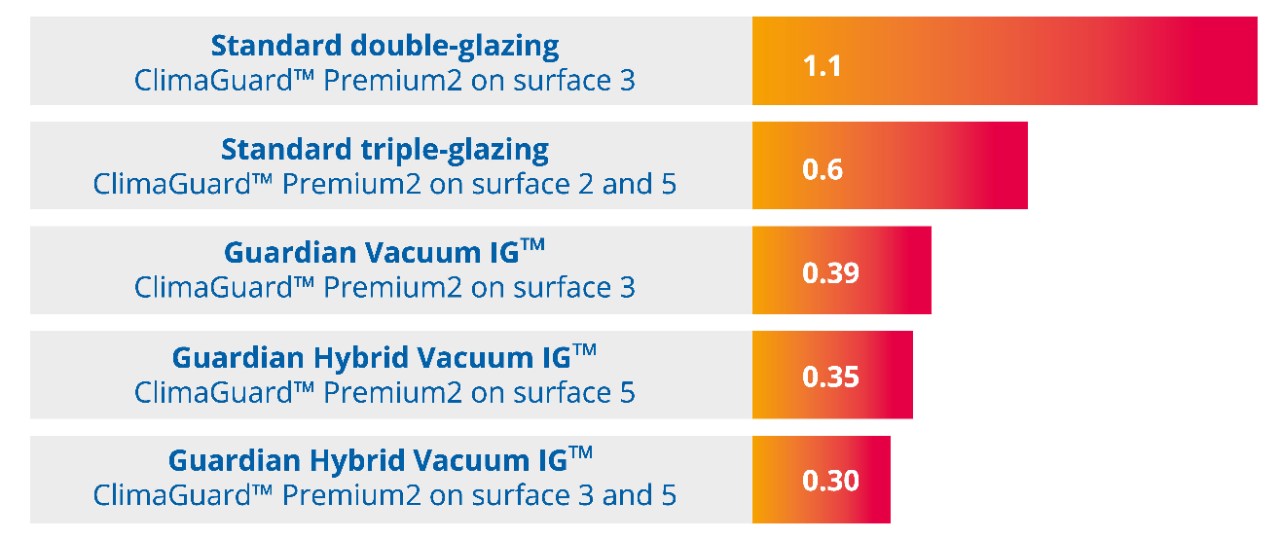
U values (W/m2K) for standard double- and triple-glazing with 4mm glass and 16 mm argon filled gaps. Guardian Vacuum IG 4mm glass/0.3mm gap/4mm glass. Guardian Hybrid Vacuum IG 4mm glass/16mm gap/4mm glass/0.3mm gap/4mm glass.

Lower embodied carbon
Architects are increasingly looking to reduce embodied carbon through material selection while meeting demanding thermal performance requirements.
Guardian Vacuum IG™ can help address both objectives. With a single ClimaGuard™ Premium 2 coating, Guardian Vacuum IG provides a Ug value of 0.39 W/m²K, compared with 0.6 W/m²K for standard triple glazing with two ClimaGuard™ Premium 2 coatings.
At the same time, its two-pane construction uses less glass than a standard triple-glazed unit, contributing to lower estimated embodied carbon for the glass components. The comparison below illustrates the estimated embodied carbon of Guardian Vacuum IG and standard triple glazing.
The estimated embodied carbon values are only for the glass components, not for additional glass processing such as tempering, or components in the build-up such as spacers, pillars or frame.
| Configuration | Embodied Carbon (eq. kg/m2)* | U-value (W/m2K) |
|---|---|---|
| Guardian Vacuum IG (4mm/0.3mm gap/4mm; ClimaGuard coating on surface 3) | 20.01 | 0.39 |
| Triple-pane IGU (4mm/16mm gap/4mm/16mm gap/4mm; 2 ClimaGuard coatings, on surface 2 and 5) | 30.73 | 0.6 |

Noise reduction
From traffic and neighbors to construction and airports, the vacuum gap in VIG serves as an effective sound barrier that dampens outdoor noise and helps create a quiet indoor environment. This is especially valuable in urban areas or near noisy sources like highways and railroads.
Compared to standard double-pane units, VIG delivers superior Sound Transmission Class (STC) and Outdoor-Indoor Transmission Class (OITC) ratings. Hybrid VIG can achieve an STC rating of 38, compared to the 34 STC of a double-pane IGU. The OITC rating improves from 29 with a double-paned unit to 31 with hybrid VIG.
The table below compares the noise reduction performance of VIG and Hybrid VIG to standard double- and triple- insulated glass units:
| Glass Construction | Rw (dB) | Rw + C (dB) | Rw + Ctr (dB) |
|---|---|---|---|
| Double-pane IGU (4mm/16mm a.s./4mm) | 30 | 29 | 26 |
| Triple-pane IGU (4mm/16mm a.s./4mm/16mm a.s./4mm) | 32 | 31 | 27 |
| VIG (4mm/0.3mm/4mm) | 35 | 33 | 32 |
| Hybrid VIG (4mm/0.3/4mm/16mm a.s./4mm) | 38 | 37 | 35 |
Testing in accordance with ASTM E90 - Hybrid VIG performance in frame. Standard double- and triple-IGUs STC and OITC values as estimated by our Acoustic Calculator.

Reduced weight and slim profile
Standard VIG is lighter and thinner than traditional IGUs, making it easier for architects to incorporate energy-efficient glazing without sacrificing design flexibility. It provides the thermal performance of a triple-glazed unit while requiring less framing than traditional double or triple glazing. This reduces structural load, which may lower embodied carbon.

Want to know more about glass and its properties?
Guardian™ Glass offers you a wealth of technical notes, tools and online learning to enhance your knowledge about glass and help you specify the most appropriate glass for your project. Discover our specification tools on the Resource Hub!

What are the applications for VIG?
VIG is suitable for enhancing both aesthetics and performance of a wide range of architectural projects. It combines energy efficiency and design flexibility to help architects create sleek, high-performing commercial buildings and is also an excellent choice for residential windows, doors, and skylights, offering homeowners a combination of energy efficiency and aesthetic appeal.
New construction
In new projects, VIG offers a way for architects to bring in natural light with enhanced thermal insulation. This can reduce energy demands for heating and cooling. The lightweight design of VIG makes it easier to install and handle, potentially diminishing logistical challenges during the building phase.
Renovations
VIG provides a means to replace single-pane or tinted glass in older buildings. Upgrading to VIG enhances energy efficiency while refreshing exterior aesthetics, making it suitable for both historical and occupied structures with limited disruption of the activities of the people inside. Hybrid VIG is especially useful for retrofitting double-glazed façades, as it fits into existing frame spaces. By adding an extra insulating layer, hybrid VIG helps lower U-values, improving thermal performance while preserving a building’s architectural integrity.
Has VIG technology been tested?
We have produced over 10,000 Guardian Vacuum IG™ units in a pilot facility, successfully installed across diverse architectural landscapes in the United States. These tempered VIG installations have proven the efficiency of VIG technology – delivering superior insulation and enhanced comfort for occupants. To see the results of this technology, explore the Boulder Community Health Center West Medical Building case study.
Logiform
*The embodied carbon data is the carbon equivalent in kg per ton or square meter of glass (CO2 eq.), emitted during the glass production (cradle-to-gate, A1-A3). The calculation is an estimation based on the material’s Embodied Carbon Factor (ECF) which were derived from the scaling factors and results in the Regional Environmental Product Declarations (EPDs), third-party, independently verified documents that communicate transparent information about the lifecycle environmental impacts of a product. Region considered for base glass and coated glass production is North America.

